Apollo Labs is a non-profit research initiative working toward cortical vision restoration — beginning as one researcher and an open body of theory, built to grow into a small group as collaborators and grants arrive. Its first contribution is Recursive Cortical Ignition: evoking a percept from individually sub-threshold pulses by letting the brain's own recurrent dynamics do part of the work.
A sub-threshold input that would simply fade in a feed-forward system is, in a recurrent one, returned to itself again and again. This amplification remains bounded while the cortex stays below runaway excitation.
In practical terms, stronger recurrent gain reduces the charge each electrode needs while extending both temporal integration and spatial coupling.
This gives a clear engineering tradeoff for stimulation design: balance local charge, timing, and spread to produce stable and interpretable phosphene structure.
Drive the cortex toward its own resonance (g₀ → 1) and the charge each electrode must deliver collapses. One hidden number sets the whole economy — which is exactly what makes the theory falsifiable: estimate g₀ two independent ways, and the predictions must agree.
From the companion preprint, Mathematical Foundations of Recursive Cortical Ignition (Zenodo, 2026). Conditional on g₀ < 1; the regime g₀ ≤ 0 reproduces the observed null results, by design.
In a conventional cortical prosthesis, every electrode must inject enough charge to be felt on its own. That single-electrode threshold caps how small and how dense electrodes can be — a hard limit on the resolution any implant can reach.
Deliver a coordinated pattern of weak, individually sub-threshold pulses instead. The recurrent excitatory dynamics of V1 amplify the coordinated pattern into a perceptible phosphene — an ignition the individual pulses could not produce alone.
The framework is formalized and its predictions are testable; its central approximation is validated in simulation and its limits stated plainly. No animal or human result supports it yet — that is the experiment to run.
The pathway Recursive Cortical Ignition aims to restore — reaching the part of the visual system that still works, when the eye no longer can.
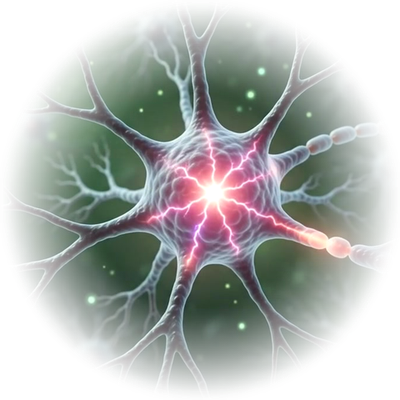
An evocative, conceptual depiction — theory stage, no device exists yet. The testable science lives in the interactive model above and in the preprints.
A Biological Sciences undergraduate at the University of Botswana who pairs formal life-sciences training with self-directed work in theoretical neuroscience, dynamical-systems modelling, and software engineering. That combination is what carries Recursive Cortical Ignition from hypothesis to formal theory, validated simulation, and open code — all authored independently, including this site and its live model. Apollo Labs is built to outgrow any one person; for now, this is the hand on the work.
Collaboration, a question, or a pointer to funding — send a note and it reaches me directly.
Recursive Cortical Ignition is theory today — rigorous, falsifiable, and open. Read the work, or help put it to the test.